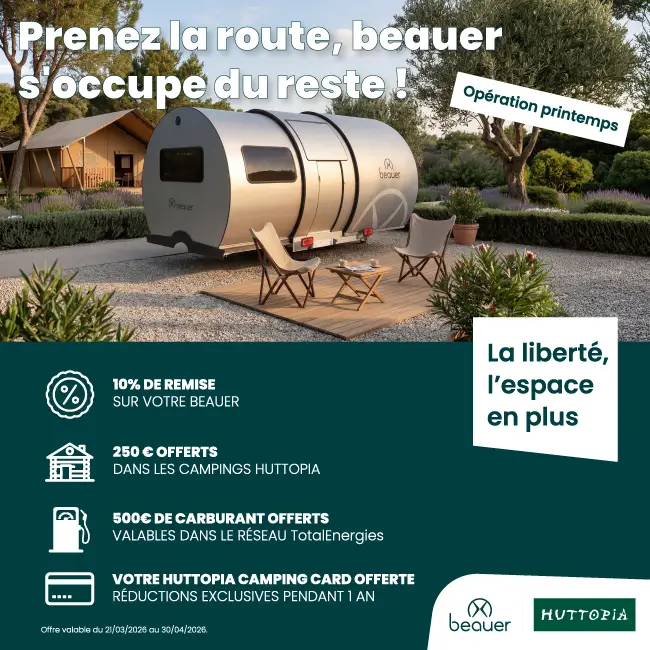
When choosing an expandable trailer, start by considering your actual needs: weekends or extended stays, traveling as a couple or with your family, and the number of sleeping spots you’ll need. Next, check whether your car can tow the combination and what driver’s license you’ll need: a Class B license is often sufficient for an X4, while a Class B96 license (a one-day training course with no exam) is required for an X6. Consider your overall budget, then visit a dealership to see a caravan in person and try extending it yourself. Finally, the Beauer configurator helps you customize a model that perfectly matches your preferences.
Why is choosing an expandable trailer unlike any other purchase?
Because an extendable trailer home leads a double life: compact on the road, but significantly more spacious once set up. Choosing the right one, then, means evaluating both how it tows and what life is like inside it.
With a traditional trailer, what you see at the time of purchase is exactly what you’ll find at the campground. With an expandable trailer, the experience changes the moment you pull over: the interior expands, more light streams in, and the living space opens up. That’s the whole concept Beauer came up with in his workshop in Puy-Saint-Bonnet, near Cholet: traveling with a compact footprint while enjoying a real sense of space when you stop for the night.
When making your first purchase, this two-pronged approach is key. It’s not enough to just compare spec sheets: you need to picture yourself on the road—maneuvering and parking—and then at the campground, enjoying your morning coffee or on rainy evenings. The following criteria will help you work through these two steps in the right order, without getting lost in the details.
Weekends or extended stays: How will you use your expandable trailer?
Your travel habits are the primary factor in your choice: they determine the level of comfort you expect, how often you travel, and how much interior space you need.
If you’re mainly planning two- or three-day getaways, you’ll be changing locations frequently. Simplicity then becomes your priority: a trailer that’s easy to hitch, quick to set up, and a pleasure to tow. This is where the expandable design really shines, as it stays compact during the trip while offering, once you arrive, an interior that doesn’t feel cramped.
If you’re dreaming of longer stays—several weeks by the sea or in the mountains—living space becomes the top priority. You’ll spend more time indoors, especially on days when the weather is bad, and you’ll appreciate a living room where you can move around freely, a kitchen where you can actually cook, and storage space that can accommodate all your luggage. In fact, many future homeowners combine both uses: weekends in the spring and fall, and a big trip in the summer. In this case, identify the primary use and choose based on that, rather than trying to plan for everything.
Also consider the seasons. Will you travel only in the summer, or during the off-season as well? The answer will help you determine your comfort priorities and enable you to discuss your needs more specifically with an advisor.
How many beds should you plan for, whether you're a couple or a family?
Plan for the number of beds needed for your most frequent use, while allowing a reasonable margin for special occasions.
For couples, comfort is the main priority: a comfortable bed that’s easy to get into without having to contort yourself, and a separate living area where you don’t have to make the bed every morning. The extra space provided by the extension is invaluable for this, as it allows two people to live together without getting in each other’s way, even during an extended stay.
When traveling with a family, the considerations are different. You need to think about the number of children, their ages, and how they’ll grow. Young children will eventually become teenagers who’ll need more privacy and space. Also consider occasional guests: grandparents, the children’s friends, or cousins staying over for the weekend. An extra bed may be enough for those occasions, without having to size the entire RV around them.
Finally, don’t just look at the number of sleeping spots: imagine what daily life would be like. Where does everyone sit for meals? Where do you store four people’s belongings? Where do you take shelter when it rains? That’s often where the difference with an expandable trailer really stands out. To explore the different configurations, browse the Beauer lineup.
What type of towing vehicle and driver's license are required to tow an extendable trailer?
You need a vehicle capable of towing the entire setup and the right license: with a Beauer X4, a Class B license is often sufficient; with an X6, you need a Class B license plus the B96 training, which can be completed in a single day.
Start with your car. Not all cars are designed to tow in the same way, and this is something you should check before making a decision—not after. There’s no need to get into technical details: the easiest thing to do is to bring your vehicle’s documentation and discuss it with the Beauer team, who will help you verify compatibility with the caravan you’re considering. If you plan to change cars in the coming years, be sure to mention it—this is a good opportunity to plan the whole setup all at once.
Next comes the question of the driver’s license, which is often a source of concern even though it’s very easy to resolve. A Class B license is sufficient as long as the combined gross vehicle weight rating (GVWR) of the car and trailer does not exceed 3.5 metric tons, which is very often the case with an X4. Above that limit—particularly with an X6—the solution is a Class B96 license. This involves a 7-hour training course, completed in a single day at a driving school. There’s no need to retake the written test, no final exam, and the cost is reasonable. Upon completion of the training, you can drive a car-and-trailer combination with a gross vehicle weight rating of up to 4.25 metric tons.
The best approach is to schedule this training day as soon as your project takes shape. That way, when your RV is ready, nothing will stop you from hitting the road.
How should you approach your overall budget?
Think in terms of the overall budget, not just the purchase price: the trailer, its equipment, the practical arrangements, and your travel plans all go together.
The price of the RV is, of course, the starting point. But a successful first purchase takes the entire project into account: the features that really matter to you, equipping your car for towing, the B96 training, insurance, and the small accessories that make your trip enjoyable. Listing these items from the start helps you avoid last-minute compromises and allows you to compare offers that are truly equivalent.
Also think long-term. An expandable trailer will serve its owners for many seasons. It’s better to choose a well-designed model tailored to your primary use and built with care than to base your decision solely on price—only to find that it no longer meets your needs after just two summers. Finally, consider the timeline: with quick and guaranteed availability when you need it, you can schedule delivery in the spring, just before the season starts, and thus avoid having to store it over the winter right away.
Why should you visit and try out the installation before buying?
Because a test setup is the only way to make sure the trailer sets up easily and that the space it saves is what you imagined.
An extendable trailer is easier to understand in person than in a photo. When you visit a showroom, ask to see the trailer in both positions: folded up, as you’ll tow it, and then extended, as you’ll live in it. The contrast is often the best way to answer any questions you might have about the concept.
Above all, set it up yourself. This process should feel natural and intuitive to you, since you’ll be doing it every time you arrive. Once the RV is set up, take the time to settle in: sit in the living room, open the cabinets, lie down on the bed, and move around as you would on a morning during your vacation. Bring along a few people if you’re traveling with your family: everyone will have a different perspective and questions you might not have thought of.
The tour is also an opportunity to talk with the people who design the RVs. You’ll see the care that goes into their construction and get concrete answers to your practical questions. To schedule this visit, simply go to the contact page.
How to Use the Configurator to Choose the Right Extendable Trailer?
The configurator lets you customize your trailer based on your priorities and preview your choices before speaking with an advisor.
Once you’ve clarified your criteria—intended use, sleeping arrangements, vehicle, and budget—the configurator becomes an invaluable tool. You can explore layout and equipment options, compare different variants, and keep track of your preferences. It’s a reassuring step: you’ll arrive at your appointment with a clear idea of what you want, which makes the discussion more productive.
To get the most out of it, sort your preferences into two categories: essentials and comforts. Essentials are what your primary use requires. Comforts include items that would make your trips more enjoyable, without being essential. This simple distinction helps you make decisions with confidence. To get started, visit the Beauer configurator, and check out our FAQ if you have any practical questions along the way.
What mistakes should you avoid when choosing your first extendable trailer?
The most common mistakes are choosing a solution based solely on price, overestimating one's needs, failing to test the deployment, and putting off practical considerations until after the order is placed.
Choosing based solely on price often leads to regrets: a model that isn’t well-suited to your needs quickly becomes frustrating. On the other hand, trying to plan for everything—every option and every situation—can make the project more complicated without necessarily improving your vacation. It’s better to choose a well-designed travel trailer that’s tailored to your actual trips.
Not trying out the vehicle setup is another common mistake: yet this step is what determines your independence right from your first trip. Finally, don’t wait until the last minute to take care of your B96 license, the car’s equipment, and insurance. If you take care of these matters early, you’ll be able to set off as soon as the car is delivered, without any delays or unpleasant surprises.
In a nutshell: How can you choose the right extendable trailer?
In short: When choosing an extendable trailer, start by considering how you’ll use it—weekends or extended stays—and then the number of sleeping spots, whether for a couple or a family. Check your vehicle’s compatibility and make sure you have a B96 license—a 7-hour one-day training course that requires no written test or driving exam. Consider your overall budget, test the awning setup during a showroom visit, and then customize your model using the configurator. For assistance at every step, contact the Beauer team via the contact page.
Frequently Asked Questions
What kind of license is required to tow an extendable trailer?
With an X4, a Class B license is often sufficient; with an X6, you need a Class B license supplemented by a B96 license. This 7-hour training course takes place over a single day at a driving school, with no need to retake the written test or take an exam. The cost is reasonable. It authorizes the driver to operate a car-and-trailer combination with a gross vehicle weight rating (GVWR) of up to 4.25 metric tons, which is sufficient for towing an expandable trailer with most vehicles.
Is an extendable trailer suitable for a family with children?
Yes, that’s actually one of its key advantages. Once set up, the expandable trailer unfolds to offer significantly more living space than in the travel position, which makes life easier for larger groups. To make the right choice, count the number of sleeping spots you’ll need on a daily basis, consider how your children will grow, and think about mealtimes and rainy days. The Beauer line offers a variety of suitable configurations.
Should you try setting it up before buying an expandable trailer?
This is highly recommended. Trying out the setup yourself allows you to see that the process is simple and intuitive, and to get a real sense of the extra space you gain once the trailer is open. During your visit, watch as the trailer is folded up and then unfolded, sit inside, and bring along the people who will be traveling with you. You can schedule an appointment through Beauer’s contact page.
How can I tell if my car can tow an extendable trailer?
Compatibility depends on your vehicle and the trailer you choose. The easiest way is to gather your car’s documents and discuss them with a Beauer advisor before making a decision, so you can verify everything at once. If you’re planning to get a new car, let us know: that way, you can plan for both the vehicle and the trailer together, without any unpleasant surprises.
When should you order your extendable trailer so you can set out at the right time?
Ideally, you should plan your project a few months in advance. Beauer ensures prompt availability when you need it, and delivery can be scheduled for the spring, just before the season begins, which avoids having to store the vehicle over the winter. Take advantage of this time to complete the B96 training, equip your car for towing, and arrange your insurance, so you can hit the road as soon as your vehicle is delivered.
What is the Beauer configurator used for?
The configurator lets you customize your expandable trailer based on your priorities: layout, features, and options. You can visualize your choices, compare different configurations, and arrive at your appointment with a clear idea of what you want. To get the most out of it, distinguish between what’s essential for your primary use and what’s simply an added convenience.