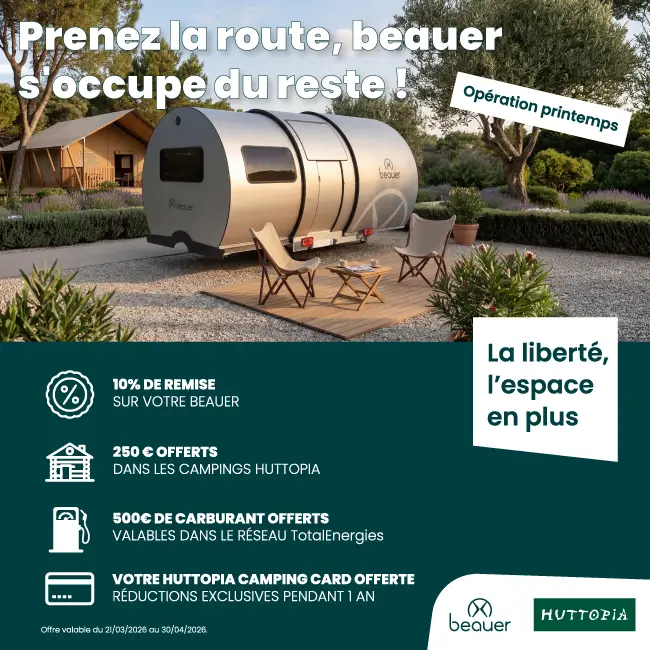
Family RV or Hotel: Why Are Families Shifting Toward Travel in 2026, and What Are the Real Comparative Advantages?
The hotel industry has long been the go-to choice for family vacations. However, since 2022, a fundamental trend has been gaining momentum: according to data from the motorized recreation sector, sales of travel trailers in France have been rising every year, driven in part by families with children seeking an alternative to standardized accommodations. In 2026, this trend continues.
There are concrete reasons behind this trend: the rising average cost of a week’s stay at a 3-star hotel during peak season—which regularly exceeds €1,500 to €2,000 for a family of four in tourist areas—the desire for greater organizational autonomy, and the aspiration for personalized vacations. The expandable trailer meets all three of these expectations at once.
What are the actual limitations of a hotel for family vacations?
Staying at a hotel has undeniable advantages: convenience, on-site services, and no need to worry about logistics. But for a family with children, these advantages quickly run up against three major practical challenges.
Space is the first limitation. A standard room, even a comfortable one, can feel cramped, which becomes a burden over a period of ten to fifteen days. Suites and connecting rooms suitable for families are available, but their rates during peak season often exceed €250 to €400 per night in popular tourist destinations.
The imposed schedule is the second constraint. The hotel structures the day around its own hours: breakfast is served between 7 a.m. and 10 a.m., the pool is open from 10 a.m. to 7 p.m., and the restaurant is closed between 2 p.m. and 7 p.m. For families with young children whose biological rhythms vary, this rigidity causes daily friction.
Repetition without capital appreciation is the third limitation. Spending 3,000 to 5,000 € per year on hotel stays over a ten-year period amounts to between 30,000 and 50,000 €, without building up any residual value. This mathematical reality is having an increasingly significant impact on the decisions of families who plan their spending for the long term.
How does an expandable trailer better meet a family's actual needs?
First and foremost, a family trailer offers a well-suited living space. A well-designed expandable trailer features a clear layout: a separate sleeping area for children and parents, a functional dining area, and easily accessible storage. This layout mirrors the feel of a familiar home, making it easy to settle in right from the start.
Organizational autonomy is the second structural advantage. When traveling by RV, the family sets its own pace without relying on anyone else. Meals are prepared according to their preferences, schedules are adjusted to fit everyone’s actual rhythm, and activities are chosen based on the weather and their energy levels at the time.
The long-term financial aspect is the third advantage. A high-end expandable trailer represents an initial investment, but offers unlimited use over many years. Over a period of five to ten summers, the cost per night automatically decreases with each additional use.
Personalization is, after all, a factor that families value more and more each year. The RV is their own space, set up to suit their habits. This sense of a home away from home significantly enhances the vacation experience.
How will families plan their RV vacations in 2026?
Planning a camping trip with children has become easier thanks to the growing number of available resources. Apps for reserving campsites and themed itineraries published by regional nature parks make planning easier without being too restrictive.
Families often opt for an effective combination: a few nights at campgrounds with amenities (bathrooms, playgrounds, swimming pools), alternating with stops in more natural settings to immerse themselves in the outdoors.
The issue of a driver’s license is often cited as an initial hurdle, but it is quickly resolved. As of February 25, 2026, a Class B license is sufficient to tow a combination with a gross vehicle weight rating (GVWR) not exceeding 3,500 kg. The B96 training course, which is mandatory for combinations weighing between 3,500 and 4,250 kg, can be completed in one day.
Frequently Asked Questions: Travel Trailers vs. Hotels for Families
How many children does it take for a RV trip to be more cost-effective than a hotel stay?
With two or more children, an expandable trailer becomes a cost-effective alternative to a hotel over a three- to five-year period. With three or more children, the cost savings are immediate starting in the first season if the trailer is used for multiple trips throughout the year.
Do children adapt easily to life in a trailer?
The experience of participating families shows that children adapt very quickly, often better than adults. The sense of adventure, the closeness to nature, and the freedom to organize their own activities are natural factors that encourage participation.
Can you use a pop-up trailer with very young children?
Yes, provided that the interior layout is adapted to specific needs: a safe sleeping area, easy access to baby care supplies, and proximity to the restroom facilities. An expandable trailer offers precisely the flexibility needed for such a layout.