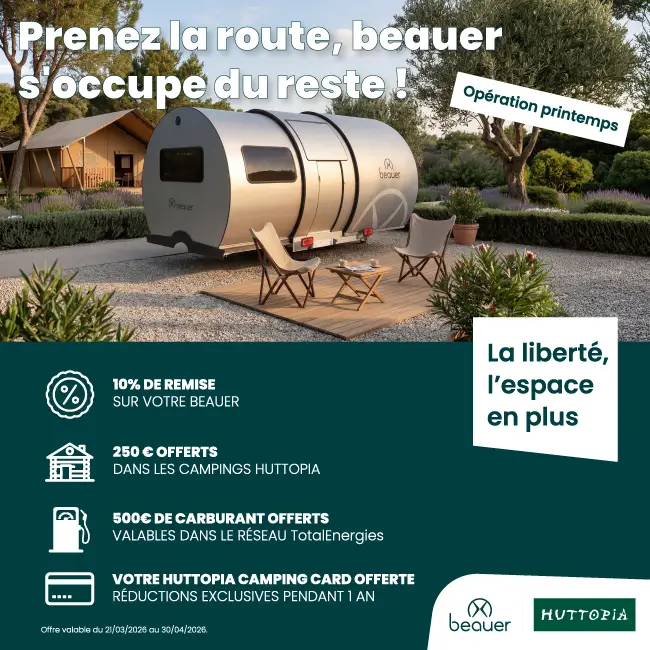
Slow travel and compact RVs: How is the Beauer Extendable the ideal tool for slow travel, allowing you to explore in depth rather than just skimming the surface?
Slow travel is no longer a niche trend. According to several studies on post-pandemic tourism behavior, more than 40% of European travelers say they want to spend more time in fewer destinations during their next trips. In France, this desire for slow travel is reflected in particular by the increase in trips lasting two weeks or more in a single geographic area.
The expandable trailer fits naturally into this philosophy. It is not designed for haste. Setting it up invites you to stop, settle in, and take your time. A Beauer parked in a meadow, by a river, or at the edge of a forest becomes the fixed point from which the slow journey unfolds.
What is slow travel, and why is it so popular in 2026?
Slow travel is based on a fundamental principle: prioritizing the quality of the experience over the number of destinations visited. Rather than traveling through five regions in ten days, the slow traveler chooses one area and takes the time to understand it, experience it, and live there temporarily.
In 2026, this approach finds particularly fertile ground. The saturation of iconic destinations, growing environmental awareness, and the exhaustion caused by a frantic approach to leisure time all converge to make slow travel appealing.
Studies on vacation well-being show that the depth of the experience is a more reliable predictor of post-vacation satisfaction than the number of places visited.
For families, slow travel offers additional, well-documented benefits. Children are better able to settle into a stable environment. Adults are able to unwind more deeply when constant change isn’t the norm.
Why is the expandable trailer the ideal tool for slow travel?
The expandable trailer shares the same fundamental philosophy as slow travel: settling in rather than just passing through. Unfolding your Beauer, setting up your living space, and arranging your outdoor dining area—these actions create a connection to the place that a hotel simply doesn’t allow.
The compact RV doesn't impose any set schedule. There's no breakfast buffet served between 7 a.m. and 10 a.m., and no activities organized by the front desk. Travelers set their own pace—with complete freedom to plan their own itinerary.
The partial self-sufficiency of the extendable trailer further reinforces this approach. Having your own kitchen, sleeping area, and personal amenities allows you to break free from the constraints of conventional tourism.
The caravan ultimately embodies a form of slow travel through its own pace: each installation naturally invites visitors to stay longer, which encourages them to savor the place rather than rush through it.
How can you plan a successful slow travel trip with your Beauer?
A slow travel experience is built around four principles. The first: choosing a cohesive region rather than an overloaded itinerary. The second: minimal, focused planning, with room for improvisation. The third: actively immersing yourself in the local community—morning markets, artisans and producers, local cultural events. The fourth: embracing planned downtime. Half-days without scheduled activities allow for genuine relaxation—something a traditional vacation schedule never leaves time for.
Frequently Asked Questions About Slow Travel in a Beauer Camper
What is the recommended minimum duration for a slow travel trip in a camper?
Ten days is the minimum amount of time needed to truly embrace the slow travel mindset. Two weeks allow you to achieve the level of relaxation and immersion that characterizes slow travel.
Is slow travel by RV compatible with having school-age children?
Yes, mainly during the long summer vacation. Five to six weeks in July and August provide the perfect opportunity to create a meaningful family slow travel experience.
How can you find the best spots for a slow travel trip in a camper?
Specialized platforms (Homecamper, Campspace, Agricamp) offer options beyond traditional campgrounds. The tourist offices of regional nature parks also publish listings tailored to long-term stays.