Two ways to travel, two philosophies. How do you choose the right one based on your needs and lifestyle?
In what ways do Beauer vehicles offer a practical alternative to traditional motorhomes?
The motorhome has long been the gold standard for road trips. It embodies independence, freedom of movement, and the promise of on-board accommodations ready to go at a moment’s notice. However, in practice, some travelers today are seeking a different approach—one that is more flexible, more adaptable, and sometimes better suited to their daily lives. It is in this context that the Beauer, extendable caravans designed and manufactured in France, offer a credible and well-structured alternative.
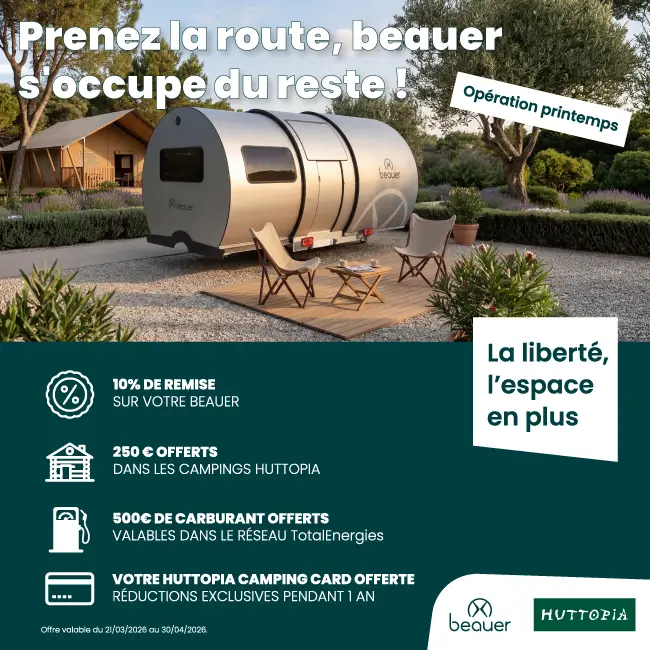
The fundamental difference lies in the separation between the vehicle and the living space. A motorhome is a single unit: the engine, driver’s compartment, and living area are all integrated. A Beauer, on the other hand, is a towed trailer that is compact on the road and expands when parked. When folded, it remains compact, easy to maneuver, and eligible for a standard driver’s license based on its gross vehicle weight rating. Once set up, it automatically unfolds using a patented telescopic system, doubling its living space in seconds.
This design offers true flexibility. The tow vehicle can be detached to move around freely while the Beauer remains parked in place. This setup radically changes the travel experience, especially during stays of several days in the same location. Whereas a motorhome requires you to move the entire living space every time you relocate, the Beauer allows you to maintain a fixed base while remaining mobile.
What is the real difference in terms of space and comfort?
The issue of space is key when choosing between a pop-up trailer and a motorhome. It is often assumed that a motorhome is inherently more spacious. In reality, this statement needs to be qualified.
A Beauer 3X+ with its awning extended offers more living space than the vast majority of traditional motorhomes. Even a standard 3X rivals—or even surpasses—many compact or semi-integrated models on the market in terms of usable space once set up. The difference isn’t just a matter of the vehicle’s exterior length, but of its ability to maximize interior space when parked.
In a motorhome, a significant portion of the structure is devoted to the driver’s cab and the engine compartment. In a Beauer, 100% of the usable space is dedicated to living quarters. This design creates a more pronounced sense of openness, with a clearer separation of the sleeping, dining, and relaxation areas.
There is, however, a difference in philosophy. The motorhome emphasizes continuity between driving and living. It is immediately ready for use during very short stops or frequent trips. The Beauer, on the other hand, truly comes into its own when parked for an extended stay. It is particularly well-suited for trips lasting several days, road trips with successive stops, or mixed uses, such as combining leisure and remote work.
When it comes to comfort, both options now offer a high standard of amenities. Both feature a kitchen, sleeping areas, a bathroom, and storage space. The Beauer focuses on smart space optimization and high modularity. Its insulation allows for extended use throughout the year, while still maintaining the flexibility of a mobile home.
What criteria should really guide your choice?
Choosing between a pop-up trailer and a motorhome requires taking a close look at your lifestyle and travel habits. The question isn’t which option is “better” in absolute terms, but which one best suits your needs.
If you prefer a single vehicle that’s ready to go at a moment’s notice and you make frequent short trips, a motorhome may be a good option. It appeals for its ease of use and its all-in-one design.
If, on the other hand, you’re looking for flexibility, true modularity, and a clear separation between travel and living space, the Beauer is an especially good fit. It’s designed for those who want to stay for a few days, keep their vehicle to get around freely, and enjoy a generously spacious living area during their stay.
Economic and technical factors also come into play. A motorhome requires maintenance of the engine and mechanical components, regular technical inspections, and specific insurance for motor vehicles. In the event of a mechanical breakdown, the entire living space becomes unavailable. The Beauer, which is independent of the engine, can be towed by different vehicles over time. This separation offers a certain degree of flexibility in long-term management.
Finally, aesthetics and brand identity are playing an increasingly important role in the decision-making process. The Beauer, with its iconic rounded design and French manufacturing in Cholet, embodies a different vision of mobile travel: more minimalist, more stylish, and more contemporary. It appeals to a wide range of customers, from traveling couples to professionals seeking a flexible mobile solution for events or tourism projects.